

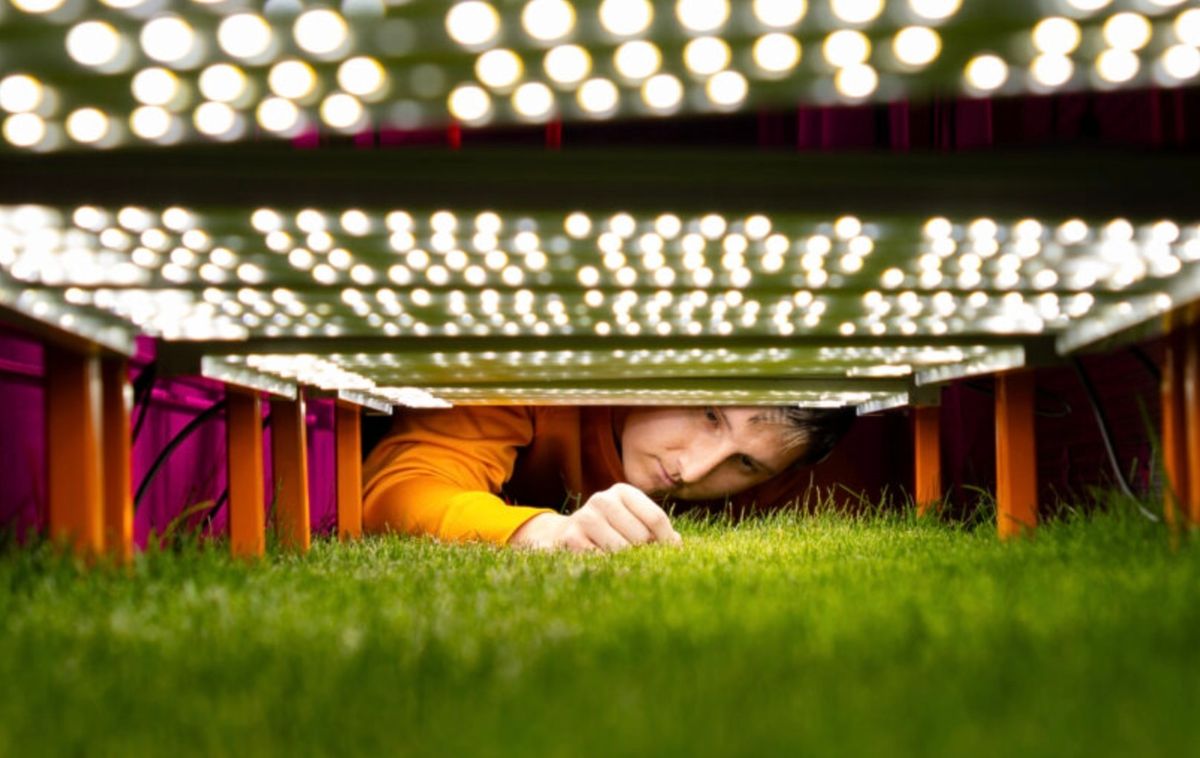
University of Tennessee Professor John Sorochan has spent the last five years preparing for this summer’s World Cup.
Sorochan isn’t an athlete, but he leads UT’s acclaimed turfgrass program, which has collaborated with the University of Michigan to develop high-quality, high-performance playing surfaces for the soccer tournament that began earlier this month.
A total of 16 stadiums across the United States, Canada, and Mexico, including Atlanta, Boston, and Kansas City, are now utilizing the natural turfgrass technology developed and tested by the collaboration. The work has provided what has been described as a “global platform unlike any the university has had before.”
“Sharing our evidence-based research for the World Cup 26 and with others from around the world means everything to me,” Sorochan said in an interview with UT’s magazine, Torchbearer.
Testing the Turfgrass
During the process, Professor Sorochan and his team of 10 turfgrass experts conducted over 170 research projects. The evidence-based data from the projects help FIFA determine the ideal playing surface and potential obstacles.
Experts had to account for factors such as grass maintenance in fully roofed stadiums, converting artificial pitches to natural ones, various grass types, and differences in surface standards.
“The focus is on consistency and uniformity,” Sorochan said in an interview with Torchbearer. “So, when an athlete is running and cutting, whether in Miami, Mexico City, or Vancouver, they shouldn’t feel any difference underfoot. Likewise, when the ball strikes the surface and reaches them, it should behave consistently.”
As an additional form of natural surface testing, the team used the fLEX Device, which simulates gameplay on turf through cleats. The fLEX Device was invented specifically by Sorochan and the associate director of UT’s Center for Athletic Field Safety, Kyley Dickson, for precise testing.
The fLEX Device ensures the team’s expertise is demonstrated and secures athletes’ safety during matches or practices.
From Lab to Field
UT’s turfgrass management program has a decades-long history of academic research. The turfgrass systems include additional irrigation, maintenance, and testing methods to produce identical pitches with no defects.
“The goal is to ensure safe and consistent fields of play,” UT’s website states.
Two of these systems are targeted for conventional rootzone, the specialized top layer of the playing surface, and a shallow profile, which means the turf is engineered with a thin base directly over another surface, such as concrete. Both systems have either bermudagrass or a mix of Kentucky bluegrass and perennial ryegrass, depending on whether the grass will be in warmer or cooler climates.
Sod, the top layer of turfgrass, is made using a hybrid stitching method that provides playing-surface stability. The pitch’s reinforced fibers are then injected into the soil as the grass grows.
Along with sod, sand root zone will also be incorporated into both systems’ middle layers, creating firmness and consistent footing.
While both systems prioritize adequate irrigation and drainage, the conventional rootzone system does so through gravel, and the shallow profile system does so with permavoid and geotextile.
Permavoid is the plastic base layer of the shallow profile system and can be more quickly removed than gravel whenever a pitch is temporary. Geotextile is a woven plastic sheeting that lies on top of the permavoid, preventing sand from filling openings and regulating moisture throughout the turf.
“All FIFA World Cup (2026) stadiums are equipped with an in-ground irrigation system with sprinkler heads that can emerge and water the entire pitch,” According to UT’s website.
A vacuum ventilation system will also be incorporated to further promote successful drainage of the natural turf.
The World Cup’s final match is scheduled for July 19 at MetLife Stadium in East Rutherford, New Jersey. The stadium is among those utilizing UT’s turfgrass research.