

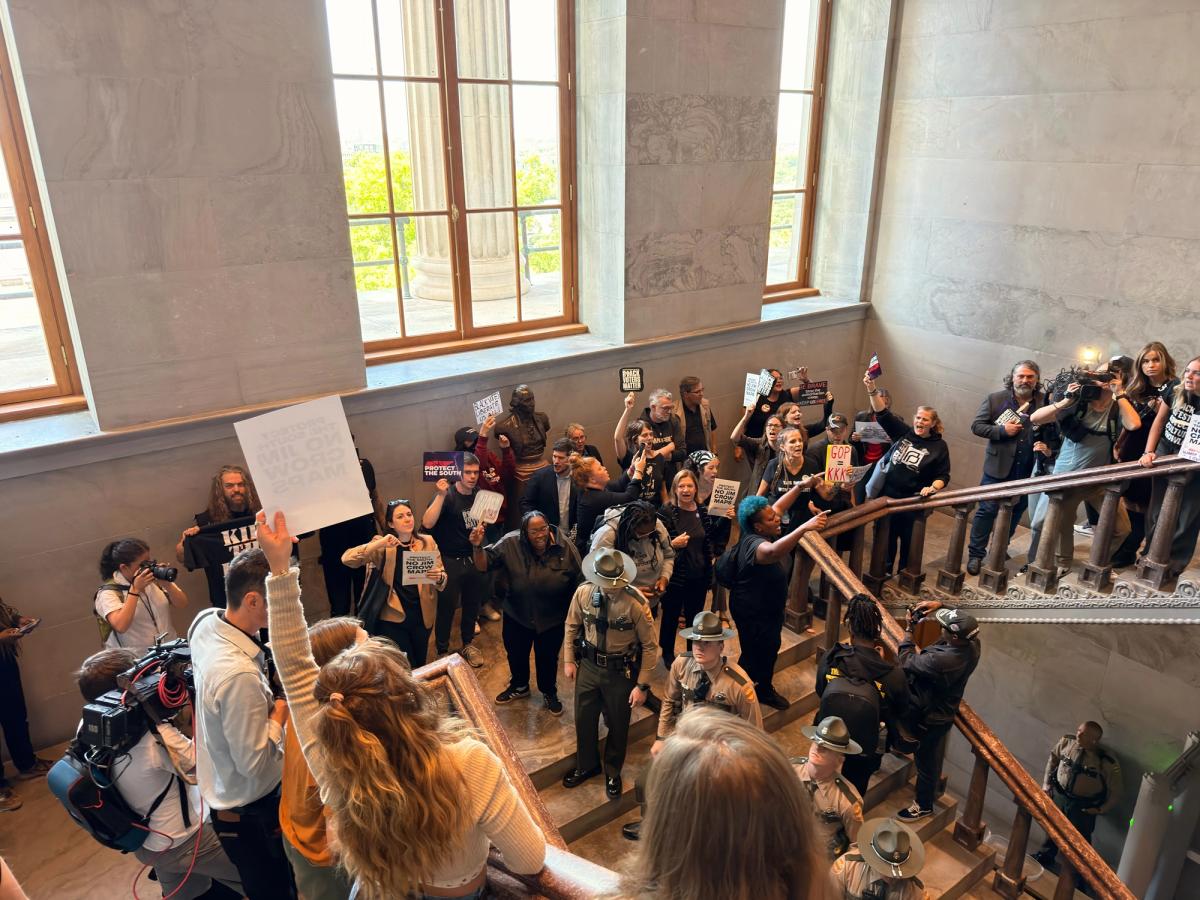
Despite protests, interruptions, and even noisemakers that were nearly impossible to turn off, both chambers of the Tennessee General Assembly passed multiple pieces of legislation during Thursday’s special session to redraw Tennessee’s congressional districts.
This new map will alter multiple districts in Middle and West Tennessee, split Memphis into three separate districts, and potentially hand the lone congressional district held by a Democrat over to a Republican during November’s midterm election. Governor Bill Lee signed it into law shortly after the session ended.

Under the new map, Congressman Steve Cohen, D-TN, doesn’t appear to live in the 9th Congressional District that he currently represents, and he’s not alone.
What the Bills Do
Multiple candidates who qualified for the August primary are impacted by the changes, including Congressman Andy Ogles, R-TN, whose home in Culleoka doesn’t reside within the redrawn 5th Congressional District.
The legislation approved on Thursday addresses this by suspending existing residency requirements. Candidates will be able to change the congressional district they are running in, and new candidates will be able to qualify for the primary if they meet a new May 15 deadline.
State Senator Brent Taylor, R-Memphis, was among the first to take advantage of this change by announcing plans to run in congressional district 9 shortly after the special session ended.
The legislation also requires state and county election officials to notify voters of the changes.
What Led to This?
The special session follows a recent U.S. Supreme Court decision on the Voting Rights Act, which held that race cannot be the main factor when drawing district lines. That ruling gives states greater leeway to base maps on political considerations, weakening safeguards for majority-minority districts and potentially allowing southern states, including Tennessee, to shift representation away from Democrats.
Calls for new redistricting efforts began last Wednesday when Sen. Marsha Blackburn, R-TN, urged action, prompting several Republican leaders to back the proposal.
Governor Lee formally convened the session on May 1, a day after President Donald Trump posted on Truth Social, urging the governor to “correct the unconstitutional flaw in the Congressional Maps” in Tennessee.
Meeting Interruptions
The first protests began on Tuesday, with hundreds of people from across the state, including many from Memphis, flooding the steps of the Capitol with signs calling the redistricting plans “fascist,” “racist,” and “bigoted.”
While the crowds weren’t as dense on Thursday, the House gallery filled out, and protestors repeatedly disrupted the proceedings with noisemakers and, at times, flying objects. Following the defeat of 36 amendments to one of the key redistricting bills, a group of protestors dropped what looked like 5-10 small baggies onto the House floor from a balcony.
Following the passage of the final bill in the House, protestors began chanting “Let Memphis go!” Democratic lawmakers walked to the front of the floor, locked arms, held up signs, joined in with the chants, and Rep. Justin Jones, D-Memphis, even produced an air horn and began using it while also holding up a sign that read, “WE SHALL OVERCOME (again.) FIGHT AGAINST WHITE SUPREMACY.”
Democratic lawmakers then walked off the floor arm in arm to protest the legislature’s decision.
Democrats Claim Racism
During debate on the four pieces of redistricting legislation, Democratic lawmakers repeatedly argued that the new map was racist and singled out Black voters in the state, nearly half of whom live in Memphis.

Some of the most pointed remarks came from Representative Justin Jones, D-Memphis, who said the maps are “racist tools of white supremacy at the behest of the most powerful white supremacist in the United States of America, Donald J. Trump.” He evoked the history of Black oppression in the south, specifically Tennessee, and equated the redistricting decision as the latest in a long line of measures taken to deny them their rights.
“This nation, this state, has legislated and legalized the worst things in humanity, including our enslavement, and we are still here,” Pearson said. “Shelby County, Tennessee, had the most lynchings of anywhere in this state, where you're taking this district, and we are still here. You've had three strikes laws, mass incarceration, denied us of who we are, and we are still here, and today you will take the only majority black district from us, but I want you to know, and I want my nephew, sons, and the future to know, no matter what you do, no matter how much you try and break us and make us bend and make us quit, we will still be here.”
Republicans supporting the new map made it a point to stress their efforts are politically based, not race-based. The Supreme Court ruling prohibits redistricting efforts based on racial makeup, but it can be based on achieving political objectives, as Republican lawmakers claimed they were intending.
Representative Jason Zachary, R-Knoxville, took questions about how the new map was drawn and what insights and data were considered in its creation. He emphasized that it came from data obtained from the 2020 census.
“This map was drafted based on politics, based on population, and the opportunity, for the first time in history, for us to send an entire Republican delegation from Tennessee to represent the state in Washington D.C.,” Zachary said.