

State legislators advanced four bills on Wednesday to the House and Senate floor that clear the way for Republicans to move forward with congressional redistricting efforts.
Lawmakers could approve Senate Bill 7001, Senate Bill 7002, Senate Bill 7004, and Senate Bill 7005 as early as Thursday morning.
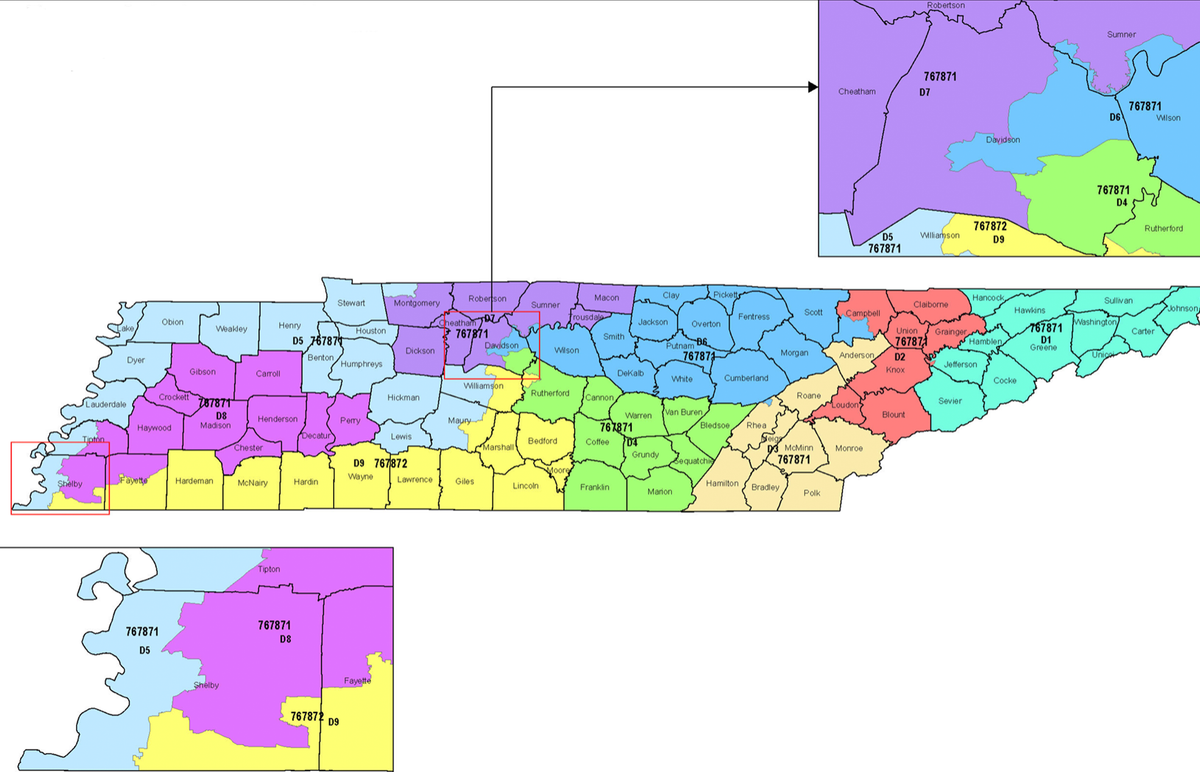
As part of those efforts, Republican lawmakers unveiled the new proposed congressional map that would split the state’s majority-Black district in Shelby County, currently held by Rep. Steve Cohen, D-TN, creating an opportunity for Republicans to pick up the seat in November’s midterms.
What the Bills Do
The new map includes widespread changes to congressional districts that extend far beyond Memphis, and some existing congressmen, like Rep. Andy Ogles, R-TN, would no longer live in their district if it’s approved.
To accommodate these changes, Republican leaders have proposed legislation to suspend existing residency requirements for the 2026 election, which is scheduled to hold a primary in three months. These changes would allow candidates to alter which congressional district they’re running for and allow new candidates to file to qualify for the primary, even though the deadline to do so passed nearly two months ago.
Under the legislation, the new qualifying deadline would be May 15.
Additionally, state and county election officials would be required to notify voters of the change
Why Some Memphis Leaders Oppose the Change
Dr. Sekou Franklin, who is the Political Action Chair of the Tennessee State Conference of the NAACP and a professor of Political Science at MTSU, was among those speaking against the proposed changes on Tuesday.
He warned that the changes would weaken the power of African American voters.
“If enacted, the proposed plan will be the most devastating attack on the Voting Rights Act, both the letter and the spirit of the law in modern Tennessee history,” Franklin said. “Simply put, the proposal, that's something that we have not seen before, and there has no precedent in modern America. It takes away the voting rights and meaningful political power of a cohesive jurisdiction that a majority black voting age population resides in in a city that is the same size as Boston, Las Vegas, and Baltimore.”
Census Concerns Raised
Congressional redistricting has traditionally followed the census, allowing lawmakers to make sure the boundaries align with population trends.
At Tuesday’s Senate State and Local Government Committee meeting, opponents raised concerns that the 2020 census data the bill would rely on is out of date and may undercount Shelby County's population, which has grown since the census was taken. However, the bill’s sponsor, Sen. Jack Johnson, R-Franklin, said there is no need for new census data.
“Any consideration of new congressional district lines will be utilizing the census data that was obtained in 2020,” Johnson said. “Using disbursements or appropriations back to local governments, oftentimes, local governments will do a special census, and I'm aware of that and have witnessed that, but this deals with consideration of redrawing congressional district maps across the state, and the best data we have to utilize for that is what we obtained in 2020.”
Election Officials Raise Concerns
Another concern raised by opponents is the impact on election officials and voters who may not know what congressional district they’re voting in if the new map is approved.
Natalie Tennant, who is the former Secretary of State in West Virginia and is currently a county commissioner in Kanawha County in the state, testified to lawmakers that the proposed redistricting would cause extra stress and legwork for election officials, voter confusion, and expanded financial costs, despite a fiscal note on the bill claiming it is “not significant.”
“I've had an opportunity to also look at the fiscal note that was sent out,” Tennant said. “That is an insult, quite frankly. It is an insult to what election administrators and voters do. It says “no significance…” I don't really know what that means, because that is an insult by saying that.”
Senator Adam Lowe, R-Calhoun, pushed back against Tennant’s concern, clarifying that the fiscal note Tennant referenced did not include the complete fiscal details of the redistricting plan.
Lowe said the state would provide funding to assist election administrators.
“There is an appropriation for the process, but in Tennessee, maybe unlike West Virginia, that's on the actionable bill, so that's not on this bill,” said Lowe. “(I) want to be very, very clear, if that bill (passes), there will be funding allocated to support election administrators in a process there.”