

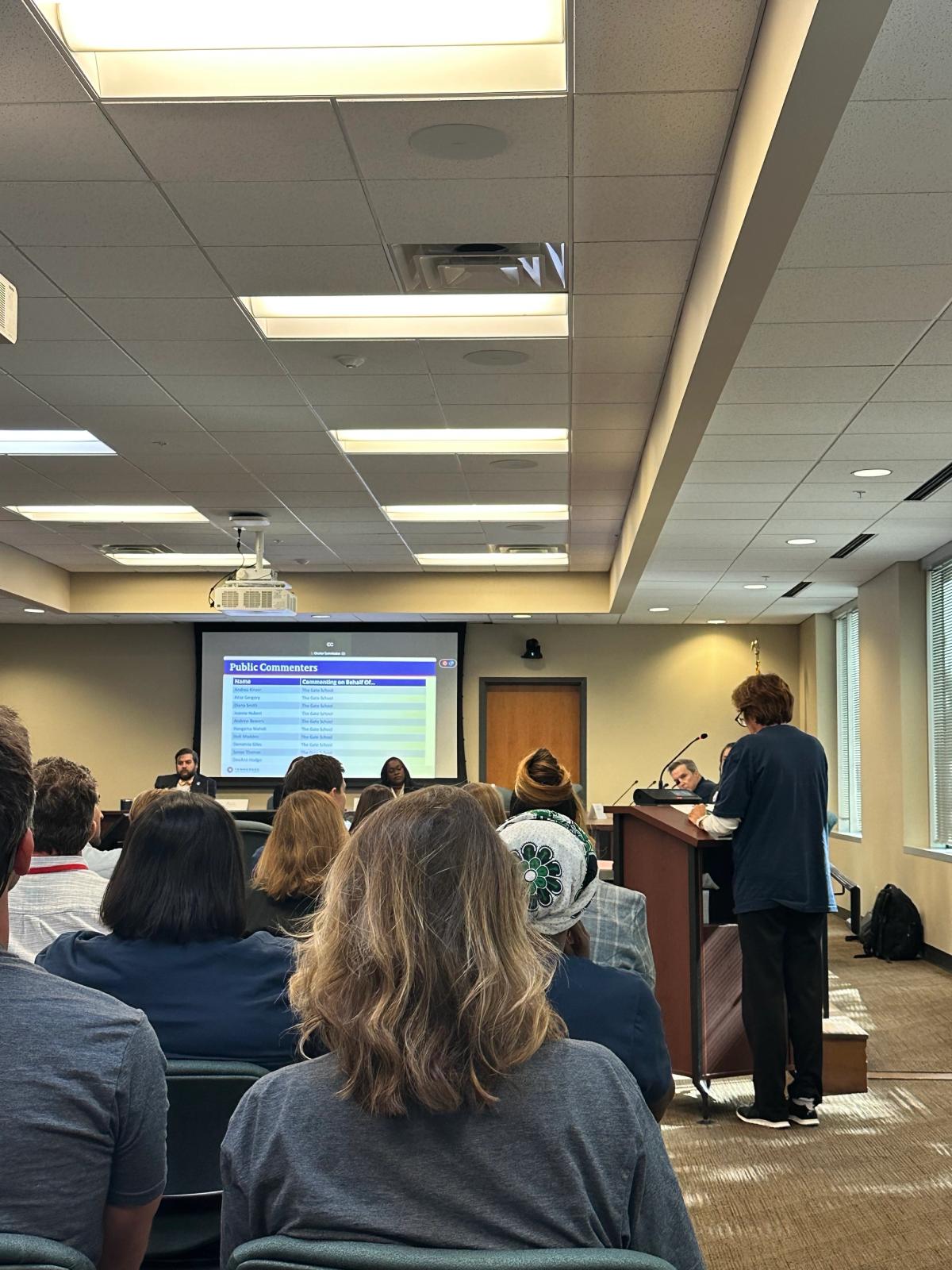
Metro Nashville Public Schools (MNPS) leaders asked the Tennessee Public Charter School Commission (TPCSC) on Friday to uphold their denial of The Gate School, a proposed public charter middle school whose amended application earned one of the highest district ratings of any Nashville charter proposal since 2014.
As in the Commission’s hearing for Music City Academy a day earlier, the district’s case rested less on the quality of the school’s plan than on its projected cost to the district.
The MNPS Board of Education voted 8-1 in July to deny the amended application for The Gate School, a proposed grades 6-8 school built around the Harkness Method, a discussion-based approach in which small groups of students and a teacher sit around an oval table. Board member Robert Taylor cast the lone vote in favor. The Gate School founder, Burrus Cox, appealed to the state Commission, which held a public hearing for both sides to make their case about the school’s authorization.
In Tennessee, all charter schools are tuition-free public schools operated by an independent contract, or “charter,” with an authorizing body like a school district or the state.
MNPS district reviewers found The Gate School’s amended application met standards in Educational Program and Design and Capacity and in Operations Plan and Capacity, including its staffing and transportation plans. Reviewers rated the Budget and Finance section as partially meeting standards, though they noted improvements between the initial and amended submissions.
District Cites Fiscal Impact
Shereka Roby-Grant, MNPS Executive Director of Charter Schools, told the Commission the budget rating stemmed largely from the application’s lack of a specific facility, which reviewers said made the school’s financial projections difficult to evaluate. She acknowledged that The Gate School addressed its facility plan during its capacity interview with the Commission and again during the hearing.
But the district’s central argument was financial. MNPS pointed to a provision of state law that allows a local board to deny an application if the new school would cause a substantial negative fiscal impact on the district. Under that law, the district bears the burden of proving the impact.
Roby-Grant described MNPS as unique because it uses a student-based budgeting model, under which more than 60 percent of the district’s Tennessee Investment in Student Achievement (TISA) allocation flows directly to schools. TISA, the state’s funding formula, is itself built on a student-based model. The district named six schools it projects would be harmed by The Gate School’s opening: West End Middle, H.G. Hill Middle, Bellevue Middle, Moses McKissack Middle, Head Middle, and Nashville Prep, which is itself a public charter school.
Commission Executive Director Tess Stovall noted that one reason for denial was the application’s failure to disclose a facility, even though a facility is not required at the application stage, and asked what reviewers had expected. District representatives said that when a location is not disclosed, they expect applicants to provide enough detail about the facilities under consideration, including occupancy classifications, code requirements, square footage, and renovation estimates, to evaluate start-up costs.
Stovall also asked about the district’s concern over a drop in the school’s renovation budget from $500,000 in the initial application to $100,000 in the amended version. The district said the reduction left reviewers unable to determine whether the funds would be sufficient for a safe learning environment.
Stovall observed that much of the district’s fiscal impact response was the same across all four charter applications it denied this year and asked whether MNPS had anything specific to say about The Gate School. MSCS Deputy Superintendent Dr. Mason Bellamy said the impact cannot be measured with “long division” across the whole district because it is felt school by school and community by community. When students leave, he said, the district may still need the same number of teachers and buses in those buildings, and opening another school dilutes the power of the dollars in existing ones.
Asked whether MNPS had considered The Gate School’s argument that it would enroll students who might otherwise leave the district in middle school, district leaders called the claim false. They said roughly 82,000 students have chosen MNPS for five years and are now being divided among more schools, and that any new students a school attracts are a trade-off for families leaving for private schools with education savings account (ESA) vouchers.
District leaders agreed that the middle school proficiency dip The Gate School cited is a statewide trend. They said MNPS is outpacing the state, investing in middle school athletics and performing arts, and has been a Level 5 TVAAS district for growth for many years.
The Gate School Pushes Back
Cox, who spoke alongside board chair Viva Price and operational partner Jim Leckrone, argued that the district’s fiscal analysis does not support a finding of substantial negative impact and that its objections rested on a misreading of the application. Since the district’s review, he said, the school has signed an agreement on a permanent facility within its catchment area with clear targets for its budget and renovation.
On the renovation budget, Cox and Leckrone told Stovall the change reflected a misunderstanding by the review team. The amended figure matched one site under consideration that would have required significantly lower renovation costs, they said, but the school’s overall budget did not change.
The school’s mission is to cultivate “student independence, effective communication, and academic excellence in the middle grades through outstanding teaching and purposeful use of technology.” School leaders said the strongest pattern in the data is that achievement drops in the middle grades, by seven points in MNPS’s most recent results, and does not recover in high school. In the school’s catchment area, they said, elementary proficiency sits around 36 percent but falls to 24 to 28 percent in middle school. Within three miles of the proposed site, middle school proficiency in English and math is about 11 percent.
Cox, who has taught at Nashville charter schools including Republic, East End Prep and Valor, first encountered the Harkness Method as a student at Ensworth. He told The Firefly in January that the approach “puts students at the center, and their voices are really the drivers.” On Friday, school leaders described a model built on three pillars: a “teaching firm” in which every educator teaches and every leader remains in the classroom, discussion-based learning, and purposeful use of technology. A four-step talent pipeline, from co-teaching apprentices to associates, senior associates, and partners, is modeled after Ember Charter Schools in Brooklyn and is designed to give teachers room to grow while keeping strong leaders close to students.
Leaders said The Gate School has raised or secured commitments for $1.1 million, covering all of its Year 0 revenue: $700,000 from private donors, local foundations and the Nashville Incubator for facilities; a $300,000 grant committed upon authorization; and a $100,000 anonymous donation contingent on approval. The school also has an eight-member board, 27 teacher resumes, and 106 current fifth graders who intend to enroll, 85 percent of whom live within the catchment area.
Stovall pressed the school on Year 1 funding after no new-start school received federal Charter School Program (CSP) funding this cycle. Leaders said they are awaiting a $250,000 SCORE grant, but even without additional fundraising, they face a Year 1 gap of about $115,000 that a Year 0 surplus could cover. Every year after that, they projected surpluses of more than $400,000 and self-sufficiency on TISA funding.
Asked about the school’s catchment zone, leaders said early interest was strong in the 37211 ZIP code and that outreach has since ramped up near the new facility. Because many early intent-to-enroll families came from Bellevue and West Nashville, the school has worked with families on early bus stop modeling so they can still reach the site. Leaders said they expect the school’s demographics to remain very similar to those described in the application.
Stovall also asked about the school’s plan for every student to take Algebra I in eighth grade. Leaders said the course opens high school pathways that would otherwise be out of reach, and that students close gaps most effectively with grade-level work paired with support, including a daily intervention block. “Expectations don’t change; the supports get stronger,” school leaders said.
On artificial intelligence, which the district said is not unique as a data tool, leaders said AI helps teachers understand and respond to how students are learning. “AI should never take cognitive lift away from students,” they said. “AI is a tool within the model to make excellent teaching more effective and responsive.”
Public Comment
MNPS board members Erin O’Hara Block and Berthena Nabaa-McKinney spoke in support of the district’s denial. Block said Moses McKissack Middle could lose up to 55 percent of its enrollment at build-out and West End Middle could lose 21 percent, potentially costing two to three teachers. She urged the Commission to read “substantial negative fiscal impact” as including the families and schools nearest the proposed school, not only the district as a whole.
Nabaa-McKinney said the new facility location represents a material change in evidence and that the board’s decision was grounded in its commitment to safeguard existing schools. She drew a distinction between money that follows a student and fixed costs the district cannot shift. “Fiscal impact becomes student impact,” she said.
As in the Music City Academy hearing, the comments supporting MNPS’s decision centered on the potential financial effect on existing district schools rather than on the quality of The Gate School’s plan.
Ten people spoke in support of The Gate School. Board member Andrea Kinzer said the school’s teaching model was soft launched at East End Prep, where “collaboration is natural, and excellence becomes the norm.”
Alise Gregory, a parent and speech-language pathologist who works in schools across Nashville, said one of the most common questions she hears from families is “where do students go after this?” She said families across Davidson County are desperate for excellent schools. “Discussion-based teaching at TGS will require students to think, not just retrieve,” she said.
Diana Smith, who served 13 years as principal of Washington Latin Public Charter School in Washington, D.C., said her school has a waitlist of hundreds of students and has retained 94 percent of its faculty for a decade, in part because every adult there teaches. Smith said she has met regularly with Cox over the past year through a NewSchools Venture Fund grant and believes he has more experience and potential to run a school than anyone she has encountered in years.
A Pattern of Denials
The MNPS board has not approved a new public charter school since 2021 and denied every application this year for the fifth straight year. The state’s Commission has overturned at least one MNPS denial every year since 2021. Under state law, if the Commission overturns three of a district’s denials within three years, charter applicants in that district may bypass the local board and apply directly to the Commission for the next five application cycles. The denials of The Gate School and Music City Academy, the two highest-rated applications in more than a decade, could trigger that threshold.
Next Steps
Executive Director Stovall will issue a written recommendation before the Commission votes on The Gate School’s appeal at its Oct. 9 Quarterly Meeting. The public may submit written comments until Oct. 2 at 9 am CST. If approved, The Gate School plans to open in fall 2027 with a founding sixth-grade class and grow to serve grades 6-8.
Interested families can learn more about The Gate School at www.thegateschool.org.