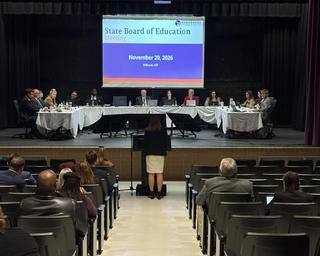


Virtual students in Tennessee are causing unexpected distortions in how the state calculates school funding, according to findings presented Thursday by the Tennessee Advisory Commission on Intergovernmental Relations (TACIR).
The commission’s research, presented by Executive Director Cliff Lippard and Research Associate Ismael Tonui to the TACIR Education Finance Subcommittee, highlights how virtual school enrollment affects counties’ fiscal capacity, a measure used to determine how much state funding a district receives.
Virtual Students Skew Fiscal Capacity Calculations
For the 2025–26 school year, virtual students impact fiscal capacity in several ways. Adding virtual students changes the average daily membership (ADM) counts that feed into the state’s funding formula. In some calculations, this makes counties appear to have more students relative to their tax base, lowering fiscal capacity. In other parts of the formula, these same students raise fiscal capacity, increasing the multiplier used to calculate total funding.
Because of this, Lippard and Tonui say counties hosting virtual schools may appear wealthier on paper, prompting the state to allocate less funding than the districts might need. Conversely, counties sending students to virtual schools could be disadvantaged in the funding formula.
“Having the residency information of each student would be an important step toward understanding the impact,” Lippard said during the meeting.
Residency Data Gaps Limit Accuracy
Tennessee’s Department of Education does not maintain complete residency data for virtual school students. Commission staff contacted Union County, which hosts the state’s largest virtual school, and found that nearly all its 2,685 virtual students do not reside in the county.
Senator Richard Briggs, R-Knoxville, asked whether the funding distortions hurt the counties sending or hosting virtual students. Lippard explained that the primary concern is the distortion itself: host counties receive the additional funding, but the way attendance is counted can unfairly alter their fiscal capacity relative to other counties.
Funding Imbalances Highlighted in Johnson County
State data shows that Johnson County’s state share of Basic Education Program (BEP) funding increased significantly, from $12,706 to $29,061 per student. This rise suggests the state may be allocating more money to the county than strictly necessary, relative to the students who reside there. Because the county hosts a virtual school, many enrolled students live elsewhere, yet state funds still flow to the host district, effectively shifting costs from local to state taxpayers.
Councilman Chase Carlisle of Memphis emphasized the practical concerns for districts: “What is each and every student getting, how does it impact the county, and other county partners?”
Looking Ahead
TACIR officials said better residency tracking for virtual students could improve fairness and accuracy in school funding, helping ensure state dollars match the needs of students across Tennessee.