

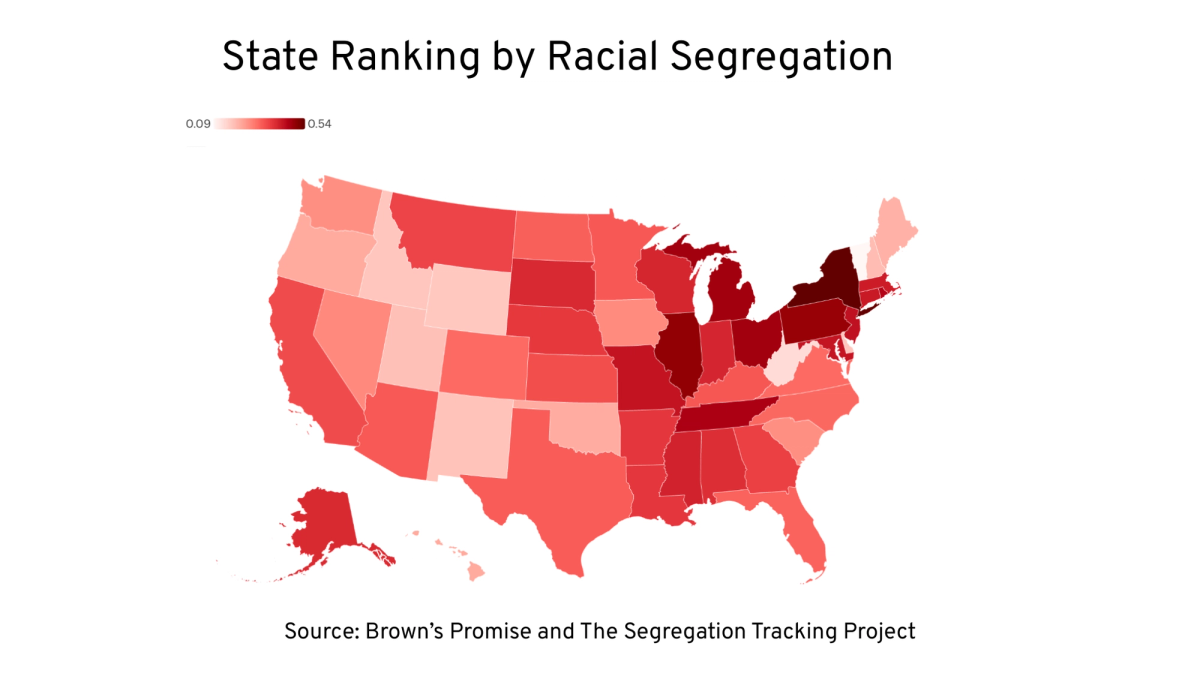
A new report has delivered some uncomfortable news about the makeup of Tennessee schools.
Brown’s Promise released a report in conjunction with the Segregation Tracking Project that revealed that United States schools are still racially and economically segregated in many areas, and the report cited Tennessee as one of the worst offenders. The Volunteer State ranked sixth in racial segregation and 20th in economic segregation.
“Segregation ensures division, while integration can lead to significant increases in school resources that produce higher outcomes–particularly for students of color,” part of the introduction for the report reads. “Additionally, research shows that school integration causes positive, permanent changes in mindset that can improve social cohesion and the health of our democracy.”
The Report’s Origins
Brown’s Promise is a research and advocacy initiative by the Southern Education Foundation dedicated to building on the values of the landmark 1954 Brown v. Board of Education Supreme Court decision, which outlawed segregating children in public schools based on race. It was founded in 2023 by Ary Amerikaner and Saba Bireda, who were both senior officials at the U.S. Department of Education under the Obama administration.
The Segregation Tracking Project is a collaboration between the University of California, Los Angeles (UCLA) and Stanford University to deliver a comprehensive resource for tracking segregation in the U.S.
The report uses data from the 2023-2024 school year and calculates its results through what Brown’s Promise calls the “normalized exposure index,” which compares two groups’ exposure, or racial makeup, to another group, for instance: Hispanic students vs. white students’ exposure to Hispanic students.
The index ranges from 0 (no segregation) to 1 (complete segregation). A higher numeric value indicates greater disparity in what different groups experience in their schools. The index also accounts for population changes, which means it can show declining segregation even if isolation among students increases.
The Results
The report gives Tennessee a 0.464 index, which means students of color attend schools where the share of students of color is 46 percentage points higher than at schools attended by white students. The report records Tennessee at a rate of 79 percent segregation between school districts, which points to districts being divided by race. However, Tennessee has a 21 percent segregation rate across school districts, meaning most districts do not have segregation within them.
The next-highest-ranked southern states are Mississippi at 13th, Alabama at 18th, and Arkansas at 20th.
Economically, Tennessee ranks 20th in segregation, with a 0.258 index, the third-highest among the southern states, behind Virginia at 8th and North Carolina at 7th. Tennessee is 49 percent segregated between districts and 52 percent within districts.