
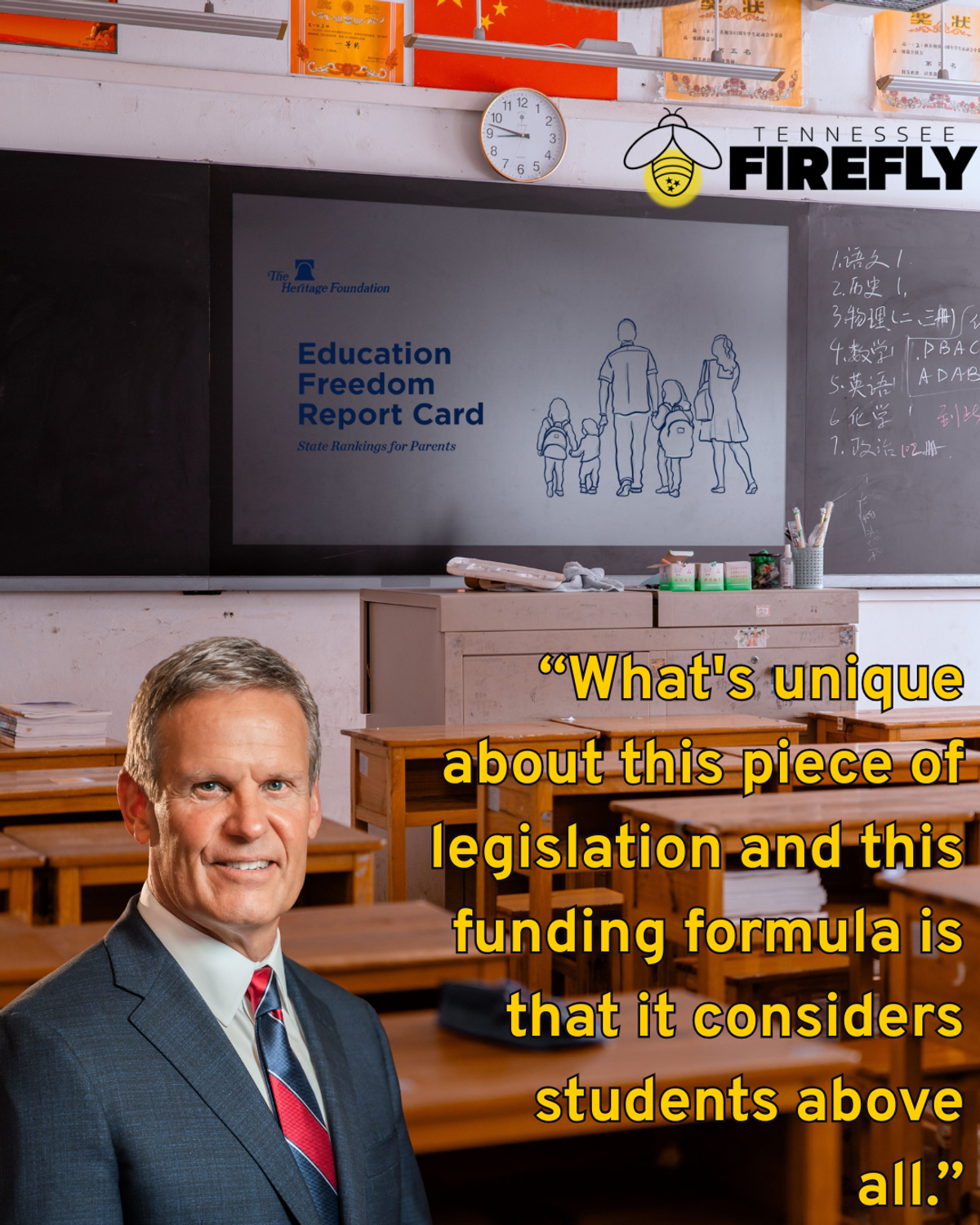
Tennessee ranks second in the nation for return on investment in education spending, according to the Heritage Foundation's 2026 Education Freedom Report Card, placing the state among the country's highest performers on a measure that compares educational resources with academic outcomes.
The report ranks Tennessee seventh overall among states for education freedom and second place for return on investment in education, reflecting its relatively low per-student spending, performance on national academic assessments, and other measures of education spending and financial management.
According to the report, Tennessee spends an average of $13,027 per student annually when adjusted for differences in the cost of living. At the same time, the state ranks 16th in its combined fourth- and eighth-grade reading and mathematics scores on the National Assessment of Educational Progress, commonly known as the Nation's Report Card.
That combination of more efficient spending compared to other states and relatively strong academic performance contributes to Tennessee's high return-on-investment ranking.
Measuring What Tennessee Gets for Its Education Dollars
The Heritage Foundation's report evaluates states across five categories: education choice, academic transparency, teacher freedom, return on investment, and civic education.
The return-on-investment category considers four primary factors: per-pupil spending, academic achievement relative to spending, the ratio of teachers to nonteaching staff, and unfunded teacher pension liabilities. Researchers combine these measures to rank each state.
Tennessee's results reflect several of these factors. The report shows Tennessee employs approximately 2.87 teachers for every nonteaching public school employee. The state's unfunded teacher pension liability represents approximately 0.1% of its gross domestic product.
The distinction is significant because education spending is often discussed in terms of the total dollars devoted to schools. Heritage's analysis instead emphasizes the relationship between financial resources and selected measures of educational performance.
Tennessee's Other Rankings
While return on investment is Tennessee's strongest category in the report, the state also received comparatively high marks for academic transparency.
Tennessee ranks fourth nationally in transparency, 16th in education choice, 20th in teacher freedom, and 15th in civic education.
The education-choice category examines policies involving public school options, public charter schools, homeschooling, and private school choice programs. Transparency considers policies related to parents' access to curriculum and school information. Teacher freedom examines policies affecting the teaching profession, while civic education evaluates state policies related to civics instruction and related subjects.
Impact of New Funding Formula
The high mark for return on investment in education could be an early indicator of the effectiveness of the state’s new education funding formula, the Tennessee Investment in Student Achievement (TISA). Passed by the Tennessee General Assembly on April 28, 2022, TISA is a student-based K-12 public education funding formula that replaced the state's 30-year-old Basic Education Program (BEP) starting in the 2023–24 school year.
The formula uses a base funding amount, then adds weighted, direct, and outcomes-based funding at the student level to better support students' individual needs.
"What's unique about this piece of legislation and this funding formula is that it considers students above all," Gov. Lee said when signing TISA into law.