

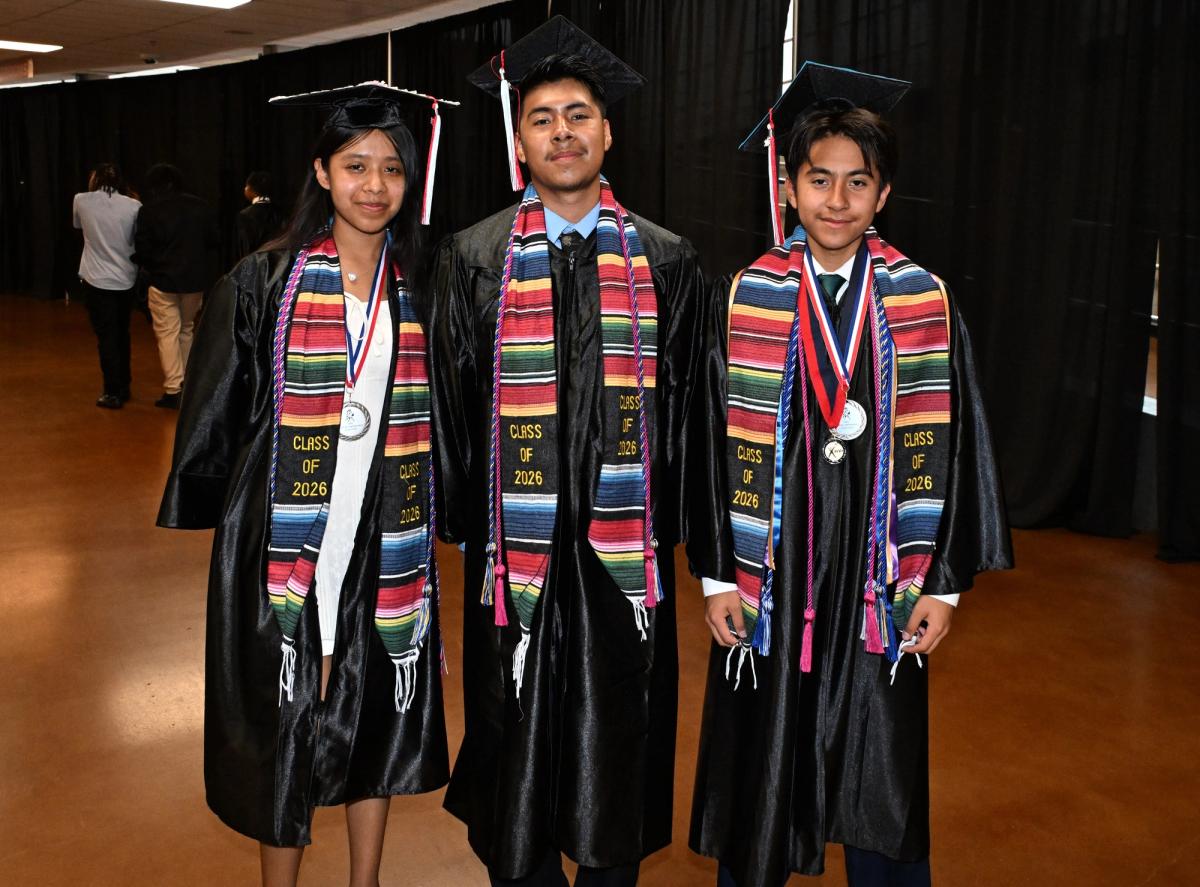
Tennessee’s high school graduation rate rose to 93.2 percent for the class of 2026, nearly a full percentage point above the 92.3 percent the state called a record last year.
That’s according to new files the Tennessee Department of Education posted to its data downloads page late last month, showing 68,723 graduates in a class of 73,774 students.
The rate has climbed each year since the class of 2023, when it was 90.6 percent. Even so, the state counted 401 fewer graduates than last year because the class itself was 1,091 students smaller.
Fewer students dropped out, too, with 4,233 dropouts in the class of 2026, or 5.7 percent, down from 5,009 students and 6.7 percent a year earlier.
Two Ways to Count
The 93.2 percent figure uses Tennessee’s own calculation, and under the federal calculation, which the state has also reported since the class of 2023, the rate was 90.9 percent, up from 90.5 percent.
A report by the state Comptroller’s office explains why there are two numbers. The U.S. Department of Education objected to Tennessee counting some students with disabilities as regular diploma earners after they met less rigorous course requirements, particularly in math, so the federal rate counts only students who complete every required math course.
That difference matters most for students with disabilities, who graduated at 85.9 percent under the state calculation and 72.5 percent under the federal one. Their federal rate has climbed from 51.0 percent for the class of 2023.
How Districts Did
Ninety-two of the 130 school systems with a reported rate graduated at least 95 percent of their students, up from 82 a year earlier, including 13 that the state lists only as above 99 percent.
A Tennessee Firefly analysis of the state’s files found 80 systems improved their rates from last year, while 40 slipped and four held steady. Lewis County posted the biggest gain, climbing 8.6 points to 91.5 percent, and Union City, Scott County, Robertson County, and Grundy County each gained more than 5 points.
Among the state’s largest systems, Knox County rose to 93.0 percent, Hamilton County to 95.2 percent, and Montgomery County to 96.3 percent. Rutherford County reached 97.0 percent, Sumner County 97.7 percent, and Wilson County 98.1 percent, while Williamson County held at 97.4 percent.
Memphis-Shelby County Schools (MSCS), the state’s largest district, rose from 84.4 percent to 85.4 percent. Metro Nashville Public Schools (MNPS) climbed from 83.6 percent to 86.4 percent, the biggest gain among the 10 largest systems. The district calls the new rate its highest on record.
Both still trail most of the state. Among local school districts, only Johnson County, at 82.7 percent, posted a lower rate than either, pulled down by Tennessee Connections Academy, an online public school the district authorizes, where 79.4 percent of 422 students graduated. Johnson County High School’s rate was 93.0 percent. On the federal calculation, MSCS rose to 84.8 percent, while MNPS slipped to 82.8 percent from 83.4 percent.
“We are continuing to make history in Nashville Public Schools, and this record graduation rate is another powerful example of what our students and educators can accomplish together,” wrote Director of Schools Dr. Adrienne Battle in a news release.
The biggest gains among Nashville high schools came at Glencliff High School, up from 61.5 percent to 80.8 percent, and Maplewood High School, up from 71.2 percent to 88.3 percent. At Glencliff, every student is paired with a staff member for all four years, Bailey Tidwell, the school’s college and career readiness coach, said in the district’s release.
“One of the things that have led us to our success in our graduation rate is building those relationships step by step and pairing each of our students with an adult in the building,” said Tidwell. “It takes a whole staff effort.”
At Maplewood, Principal Sonya Brooks said staff members meet with each senior at least once a month to keep students on track.
“I think the collaboration among teachers, school counselors, and all stakeholders has been the main reason our graduation rate has increased,” said Tristin Johnson-Williams, a school counselor at Maplewood for 13 years. “We have been very intentional.”
Gaps Between Student Groups
Students in foster care graduated at 57.6 percent, the lowest rate of any group the state reports, and 38.2 percent of them dropped out.
Homeless students graduated at 82.0 percent and English learners at 82.2 percent, up from 78.6 percent a year earlier. Economically disadvantaged students graduated at 88.9 percent, compared with 95.5 percent for their classmates.
Families can find their district’s rate in the department’s district file and their high school’s rate, broken out by student group, in its school file.