
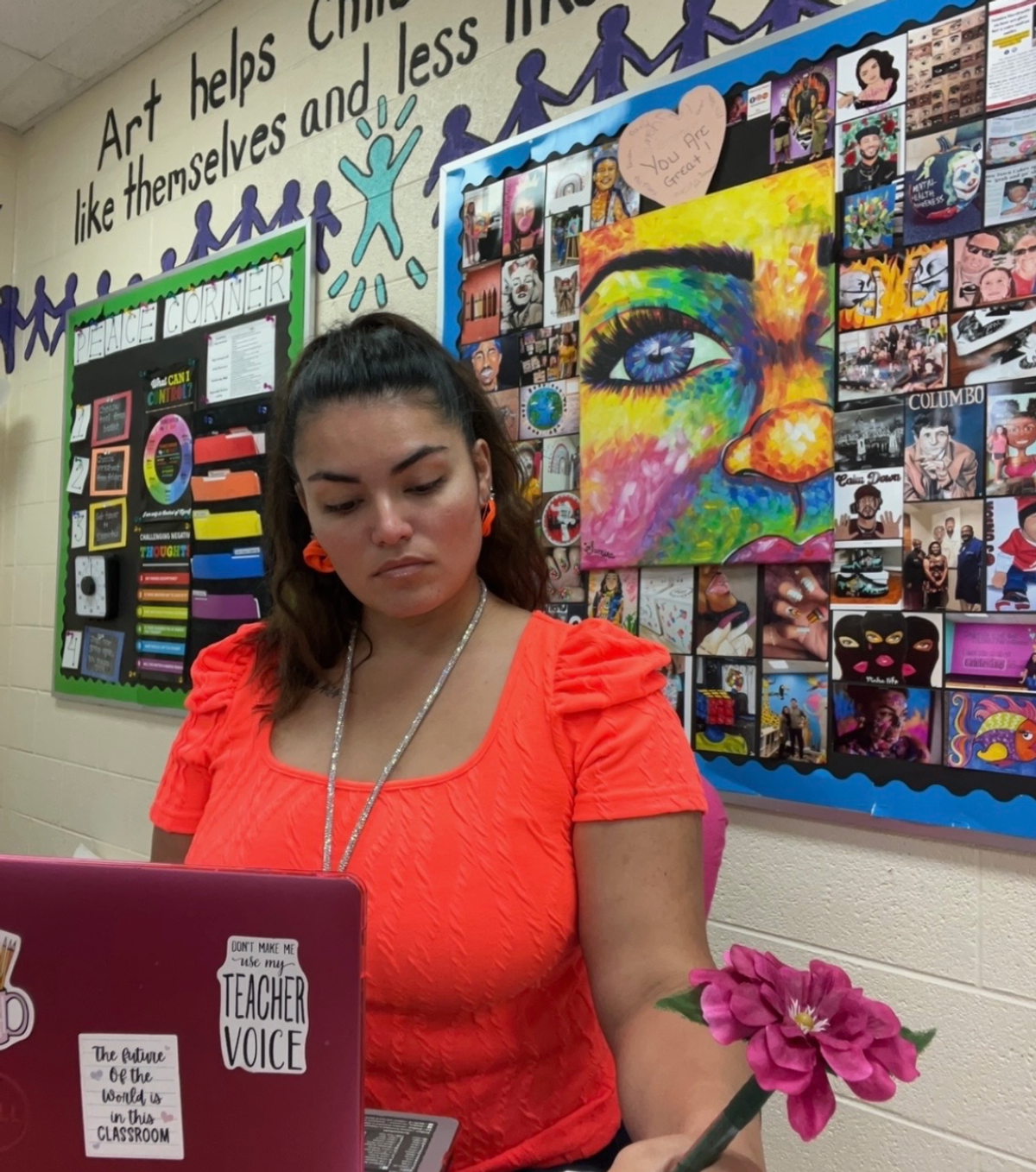
Samira Hardcastle, who was named Teacher of the Year at John F. Kennedy Middle School last year, submitted her letter of resignation in April.
Last week, Hardcastle explained why during the Metro Nashville Public Schools Board of Education meeting, where she accused district leaders of asking her to fabricate a student’s grade.
“What happens when these kids lie, cheat, and cry their way through school and end up as future doctors, police, or politicians?” Hardcastle said during the meeting. “When will you protect the future of our society?”
The former art teacher alleged that pressure to inflate students’ grades to cater to demanding parents, rather than supporting its teachers, has been an ongoing problem.
She sat down with The Tennessee Firefly to elaborate on the circumstances surrounding her resignation.
The Allegations
In her resignation letter, Hardcastle said the district’s handling of an incident with one particular parent solidified her decision to leave.
“(This parent) has a past of harassing 30+ teachers in Metro alone,” part of Hardcastle’s resignation letter read. “She has circled employees with her car when she does not get her way. She has shown up with her child to field trips her child behaviorally did not earn, just to record the other kids. One of our teachers even filed a police report because she feared (for) her safety! Yet, the lady is still -to this day- on a rampage, and MNPS has not stopped her and protected its teachers.”
Hardcastle said that the parent started harassing her via email last school year and demanded that she give her child a passing grade after the student did not complete a final project, or a retake that was offered to them.
The former teacher told the Tennessee Firefly that she was surprised when her former principal decided to give the student another chance to turn in the project, noting that district policy included multiple retake opportunities for students.
“I could not find that policy anywhere…I don't know if it exists,” Hardcastle said. “But by this time, (they are) no longer in my class, so the quarter's over, which is another problem.”
The student was allowed to complete the project at home after the school year had technically ended, but Hardcastle said the student still failed to turn it in by the district’s deadline and was then given more time to complete it.
Afterward, Hardcastle claims district officials met with the student’s parent and decided to allocate an ‘A’ on the assignment without consulting her. She says the student in question was failing other classes as well, and other teachers had been pressured to pass her along.
Hardcastle does not plan to teach again and is currently selling her own art through her Artwork By Samira Facebook page.
What Does District Policy Say
MNPS district policy gives its schools discretion for retakes and missed assignments. John F. Kennedy Middle School’s policy on due dates reads: “Makeup work for excused and unexcused absences should be submitted within the agreed upon timeframe specified by the school. Makeup work will be graded without penalty when submitted within this timeframe.”
Under this rule, it’s possible that JFK may have violated its own policy in giving the student an A despite failing to complete the assignment "within the agreed upon timeframe specified by the school."
The nearby Antioch High School has a more robust statement on due dates.
“Establishing, maintaining, and holding students accountable for due dates is necessary to assist students in the development of skills such as organization, time management, problem solving, and collaboration, as well as in the development of individual responsibility and self-discipline,” the statement reads. “Establishing, maintaining, and holding students accountable for due dates and deadlines are also necessary for teachers to adequately and efficiently manage their workload. It is vital that students complete work on time because it will support the preparation for summative assessments.”
The policy states that missing work is recorded as an “M,” which counts as a zero, and that all late work must be submitted within one week of its original due date, with no late work accepted during the last week of the nine weeks. 
MNPS Response
A spokesperson from MNPS pushed back on Hardcastle’s allegations, saying that no schoolwide policy prohibited the student from being offered another opportunity to complete the schoolwork.
“The information provided by the former art teacher at John F. Kennedy Middle does not fully reflect what occurred, based on the school principal’s account and the information we have been able to review in the limited time available,” part of the district’s response reads. “After the work was submitted, the principal independently reviewed the assignment and determined the score it earned based on the work submitted and the expectations for the assignment. The principal did not select a score for the purpose of producing a particular final course grade. The resulting course grade was the mathematical result of the score assigned to the completed work.”
The district’s full response is available here.
The Implications of Grade Inflation
A University of Texas study published this year found that grade inflation has been a long-standing problem nationwide and that the national average high school GPA has risen by 0.48 points over the past 40 years.
The study also found that grade inflation generally harms students in the long run; teachers who give higher grades than students earn tend to inhibit future learning, graduation rates, college attendance, employment, and earnings.
The study separates grade inflation into two categories: mean grade inflation, when teachers give students higher grades on average than their test scores and past academic performance would predict, and passing grade inflation, when teachers are more likely to change a failing grade to a passing grade.
Average grade inflation, according to the report, lowers future standardized test scores and makes students less likely to graduate from high school, have attendance and discipline problems, or take the SAT. While some say that passing grade inflation might have benefits, the report said any possible benefits would not translate into strong long-term educational gains.
Grade inflation is also linked to students being less likely to enroll in college or complete the degree plans they enter. Students are also less likely to be employed after high school and earn less money during early adulthood.