
As the August 6th election day quickly approaches, gubernatorial candidates have been making their final appeals to Tennesseans, with a substantial percentage of projected voters yet to cast ballots.
One common tactic used by campaigns in the final weeks of a cycle is to publicly release polling data, generally with the intention of persuading voters to join the perceived “winning side,” or to drive turnout—voters may be more likely to come to the polls if they believe an election to be close and that their vote could perhaps be the deciding one.
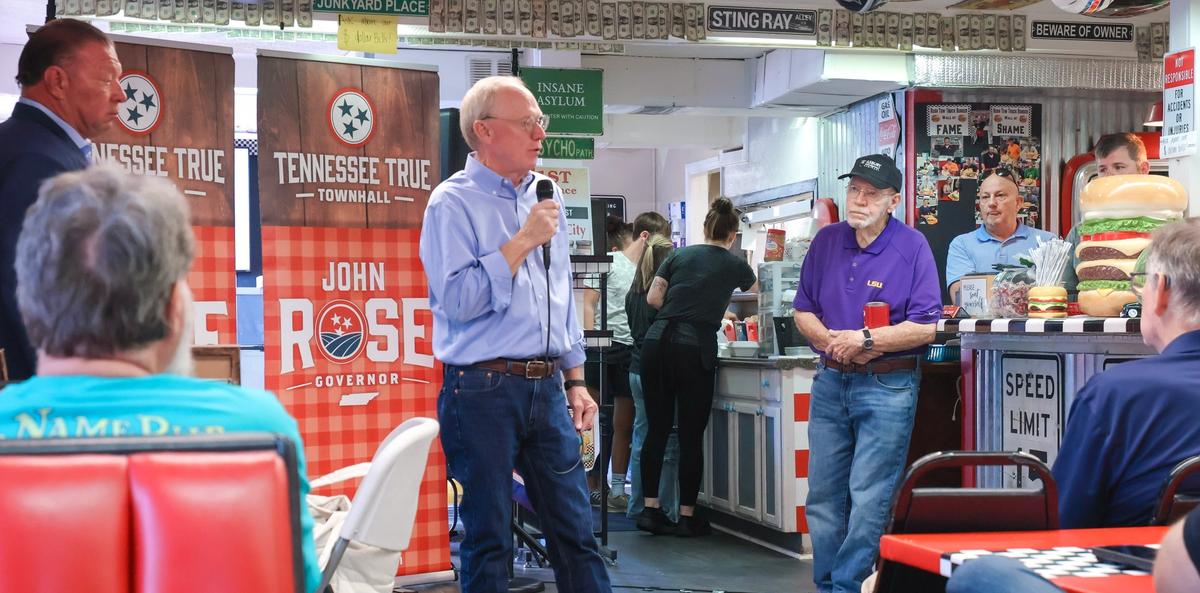
On July 31st, a supposedly independent poll (i.e., one not officially commissioned by a campaign) conducted by OnMessage Inc., a D.C. political firm, surprised many with a “dead heat,” placing John Rose just 3.5 points behind longtime frontrunner Marsha Blackburn.
Setting aside the fact that such a deviation from earlier data is difficult to believe—Blackburn has held a commanding lead in every independent poll conducted this year—there are other concerns with the poll that should cause Tennesseans to take a more critical look.
Methodology Matters
The predictive capability of a poll is driven primarily by its sample quality. Regardless of how large a poll’s sample may be, if it does not accurately represent the larger population that the poll is attempting to predict behavior in, the data can be, in some cases, wildly inaccurate.
The most notorious example of this occurred in the 1936 Literary Digest poll during that year’s presidential election. The largest of its kind ever conducted with 2.3 million respondents, the poll predicted Republican candidate Alf Landon would defeat incumbent Franklin D. Roosevelt in a landslide.
Of course, the poll was wrong. FDR defeated Landon by an even larger landslide than what was inversely predicted. The fatal flaw? Literary Digest derived its sample from phone directories and automobile registration records, which drastically oversampled a more affluent segment of the population, as many working-class Americans did not own a car or telephone during the Great Depression. The sample did not accurately reflect the makeup of the electorate, so it failed to make an accurate prediction.
The same principles apply in any polling conducted today. For a poll sample to have any predictive capacity, it must effectively model the larger population. Pollsters today pride themselves on utilizing cutting-edge technology and proprietary models, claiming to have the best formula for determining the outcome of an election. Factors considered may include geographic diversity, age groups, education levels, marital status, and even consumer trends.
Bottom line—the sample used in a poll is the single most important factor when assessing its credibility. Any publicly released polling data that does not disclose its methodology should be immediately suspect to the discerning voter.
Potential Bias
Because publicly releasing polling data is a powerful tool for campaigns—driving momentum, fundraising, endorsements, and turnout- there is a strong incentive for candidates to release the most favorable data and suppress unfavorable statistics.
Polls officially commissioned by a candidate and his campaign are more likely to demonstrate these biases, especially when the numbers deviate strongly from independently commissioned polls.
Though the OnMessage Inc. poll, which showed a “dead heat” between Rose and Blackburn, was reportedly conducted independently, campaign finance reports show a strong relationship between the D.C. political firm and the Rose campaign.
Since the 2025 end-of-year financial disclosure, John Rose’s campaign has reportedly given $10,325,138 worth of business to OnMessage Inc., including direct mail, media buys, and advertising. OnMessage previously conducted polling for Rose in his 2018 congressional bid, and one of the firm’s partners has donated to Rose’s gubernatorial campaign directly.
Though an article in The Tennessean acknowledged some association between Rose and the firm, this was severely understated in light of the enormous financial stake OnMessage appears to have in Rose’s campaign.
It is difficult to imagine that such a considerable financial and personal bias towards Rose would not be reflected in publicly released polling data.
Bottom Line: Be Critical
Despite massive technological advancements in data science and predictive modeling, polls can still get it wrong, and they can often be employed more as a persuasive tool for campaigns rather than an informational guide for voters.
Voters should carefully consider the sample used in a poll and whether it was commissioned independently or by a campaign. If the poll did not release any information about its sample or was not transparent about its associations with either of the candidates, a red flag should immediately go up.
Unlike the OnMessage poll, Marsha Blackburn’s most recent poll, conducted by Fabrizio, Lee & Associates, was transparent about its sampling methodology and official ties to the campaign. Unless OnMessage was willing to publicly release more information about its methodology that would suggest otherwise, Marsha’s polling appears to be more accurate.
Tennesseans for Student Success Action is a political action committee devoted to elevating education policy to the forefront of political campaigns, recruiting and training education heroes for public office, and helping them win at the ballot box.