
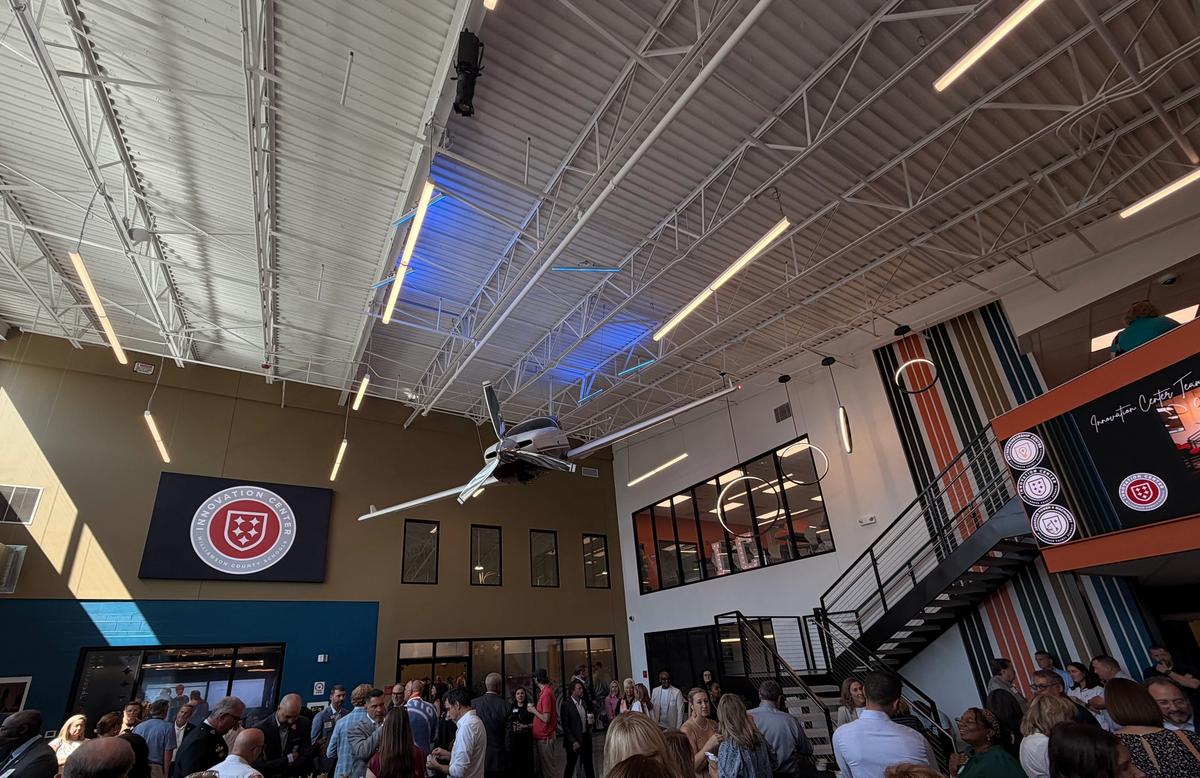
After five years in development, the Williamson County Schools Innovation Center opened in August, and its proponents could not wait to show it off.
The Williamson County Chamber of Commerce presented the State of the Schools: An Immersive Tour and Chamber Luncheon at the Innovation Center on Thursday, where students and staff showed dozens of attendees the 26,000-square-foot facility and its amenities.
The Innovation Center
The Williamson County Innovation Center was funded by $15.5 million from the Tennessee Department of Education Innovative School Models grant.
“One of the big things that happened with this innovation grant is that all the way from the governor's office to the Department of Education really challenged schools to think differently, think innovatively about your approach to education and how we prepare students not only for college and career readiness but prepare them for the world that awaits them,” Williamson County Schools Interim Superintendent Dr. Leigh Webb said in a district YouTube video covering the center’s ribbon-cutting event last month.
In the same video, the center’s executive director, Dr. Jeremy Qualls, said he was most excited to see students use their training to go straight into the workforce after completing a program.
The center provides five career-focused programs for the 2026-2027 school year and beyond: cybersecurity and AI, aviation, hospitality and tourism, fire management, and advanced power and machinery. At the luncheon, guests toured the facility, allowing them to see each program’s space firsthand and speak with staff.
Logan Schlosser, a Williamson County Schools senior, described his work in the advanced power and machinery course as “hands-on.” The day usually begins with reviewing previous work, exploring what that day’s schedule will look like, and then presentations where students learn what they are going to do that day.
The program resides in a large workshop area filled with tools, machinery, lockers, a classroom space, and more. Tennessee College of Applied Technology (TCAT) instructors administer the training in most cases.

Schlosser said he joined the program because he wanted to focus on electrical engineering as a career path after graduation. The program has two paths: a diesel assistant certificate and electrical assistant certificate. Still, he wants a working understanding of both and said the center gives him opportunities to learn in both pathways that a regular high school campus cannot.
“I’m hoping one day they’ll connect those bridges,” Schlosser said.
The partnerships the program forged with companies such as Thompson Machinery and Caterpillar allowed the center to source parts, including entire engines, for students to work with. He said most, if not all, of the engines they receive have problems with them or internal failures.
Representatives from the center’s Fire Management program explained that it trains students to be hired by the Franklin Fire Department immediately after completing the program. They can also complete a 19-week paid internship after graduating high school, training full-time at the Franklin Fire Training Center.
“They go straight into the workforce and don’t have any college debt,” one representative said. “By the time other kids are graduating from college (at) 22 years old, they’ve already been working for three or four years.”