
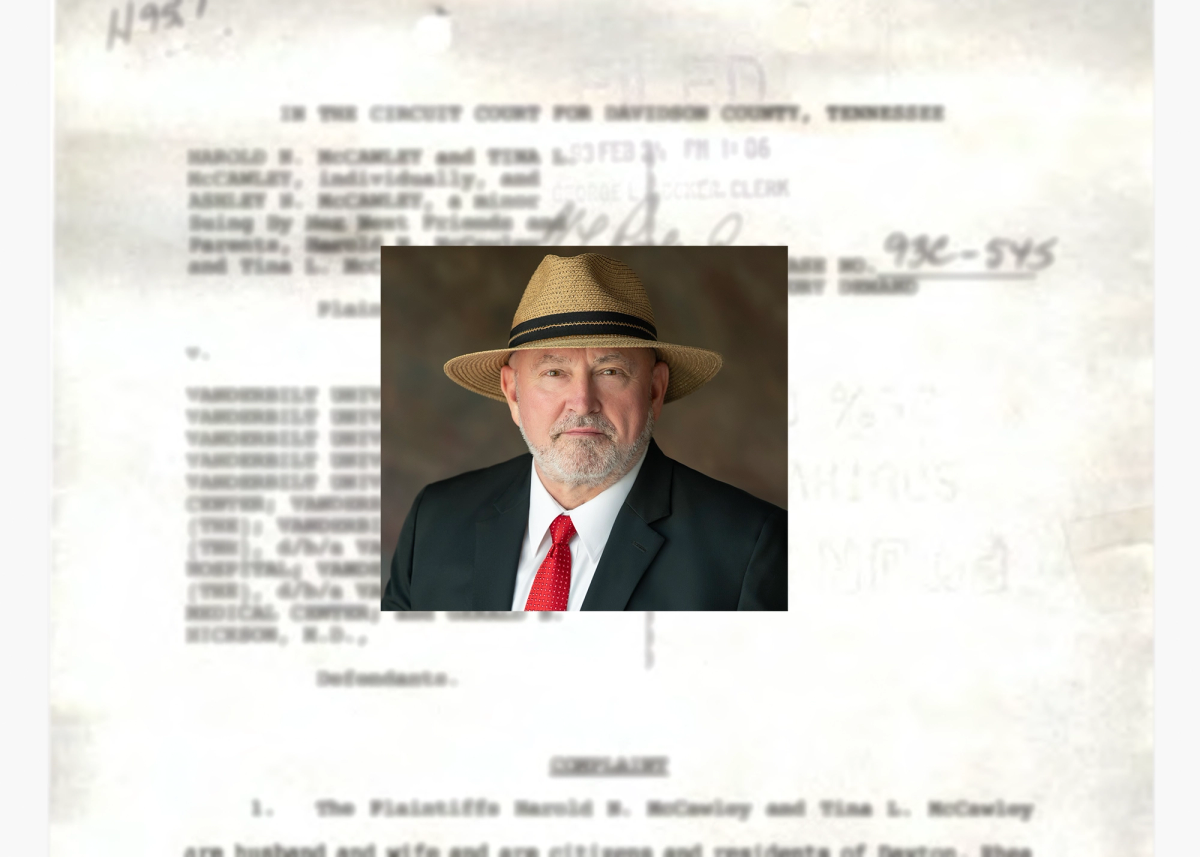
A decade before he first ran for a Rhea County School Board seat in 2004, Harold “Bo” McCawley filed a civil lawsuit for up to $1 million against Vanderbilt University, Vanderbilt Medical Center, and one of its doctors.
That case involved multiple statements detailing child abuse allegations by the doctor against McCawley and his wife, Tina, before a Circuit Court Judge dismissed the lawsuit in 1995.
McCawley, now a candidate for state representative in District 31, which covers Rhea, Sequatchie, Bledsoe, and Van Buren counties, has not previously addressed the lawsuit and its details publicly.
Evidence Discovered by Doctors
Reporters from the Tennessee Firefly reviewed dozens of documents to piece together the story that began in October 1990, when McCawley took his then four-year-old daughter to the family’s pediatrician, Dr. Marian May. At the time, the girl was suffering from a skin condition that created small knots on her legs and abdomen – referred to as nodules.
According to lawsuit documents, Dr. May sent a tissue sample to a St. Louis pathologist who produced a list of possible diagnoses, including Munchausen syndrome by proxy.
“Which is a form of child abuse in which a perpetrator motivated by a desire to obtain access to medical attention may physically abuse a child to create signs or symptoms of an illness,” wrote Judge Hamilton Gayden in his order dismissing the case.
Dr. May was unable to definitively diagnose the child’s condition and relayed the information and possible abuse concerns to Vanderbilt Medical Center, Dr. Gerald Hickson. He examined the girl in May 1991.
Legal documents reveal multiple factors that led Dr. Hickson to suspect that Munchausen syndrome by proxy might be the cause of the girl’s symptoms, including the presence of needles in the house and the behavior of her parents.
“First, a nurse informed Dr. Hickson that (the girl’s) parents expressed concern over (her) medical records and the information that had been transmitted to Dr. May,” wrote Judge Gayden. “According to Dr. Hickson, incredible interest in medical records may be a sign of Munchausen’s syndrome by proxy. In addition, (the girl’s) parents had marked each of the knots on her body with a blue ink pen; conduct which may also be characteristic of Munchausen’s syndrome by proxy.”
Dr. Hickson additionally asked three other Vanderbilt physicians to examine the girl. All three submitted affidavits that supported his diagnosis of Munchausen by proxy.
“There was no clear clinical diagnosis for the cause of the nodules, and many features of (the girl’s) case were indicative of child abuse,” wrote Vanderbilt Dr. Mark Perkins.
State Custody and New Diagnosis
Seven days after the examination, Dr. Hickson submitted a letter to the Tennessee Department of Human Services (DHS) detailing his concerns. The department filed a petition to place the girl in the care of her aunt the following month, which in turn led McCawley to request a second medical opinion from Dr. Noel Frizzell at LeBonheur Children’s Medical Center in Memphis.
Dr. Frizzell examined the girl in July 1991 along with a team of subspecialists and diagnosed her condition as dermatomyositis, according to legal documents. 
“All of the attending physicians at LeBonheur Children’s Medical Center unequivocally agreed that (the girl) was not suffering from Munchausen syndrome by proxy but was seriously ill with dermatomyositis, a form of muscular dystrophy,” said Frizzell. “Had Dr. Hickson observed standard medical practice in his care and treatment of (the girl), the humiliation, suffering, and pain caused to the McCawley family would have been avoided and the child would not have been delayed in receiving appropriate medical treatment for her serious illness.”
How the Case was Dismissed
The state returned McCawley’s daughter to his care one month after Dr. Frizzell’s dermatomyositis diagnosis, and Bo McCawley filed his lawsuit a year and a half later.
A Circuit Court Judge officially dismissed the case in May 1995, ruling that attorneys failed to prove that Dr. Hickson “reached his diagnosis in bad faith.”
In every legal document reviewed by the Tennessee Firefly, Dr. Hickson has stood by his initial diagnosis, and he even claimed to have considered dermatomyositis as a cause before ruling it out.
“I eliminated that possibility based upon the results of the laboratory tests conducted by Dr. May and because (the girl) had no apparent muscle weakness, no facial rash and no constitutional symptoms,” wrote Hickson.
Reporters from the Tennessee Firefly reached out to Bo McCawley for comment on this story, and he declined to respond.
The Tennessee Firefly’s mission is to strengthen communities through factual, local-focused journalism that increases public awareness and civic engagement. All information presented in this story comes directly from court documents.