
Each month, school board members across the state weigh in at meetings on items they’re voting on, but they do not typically take questions from reporters on key issues as often as other elected officials.
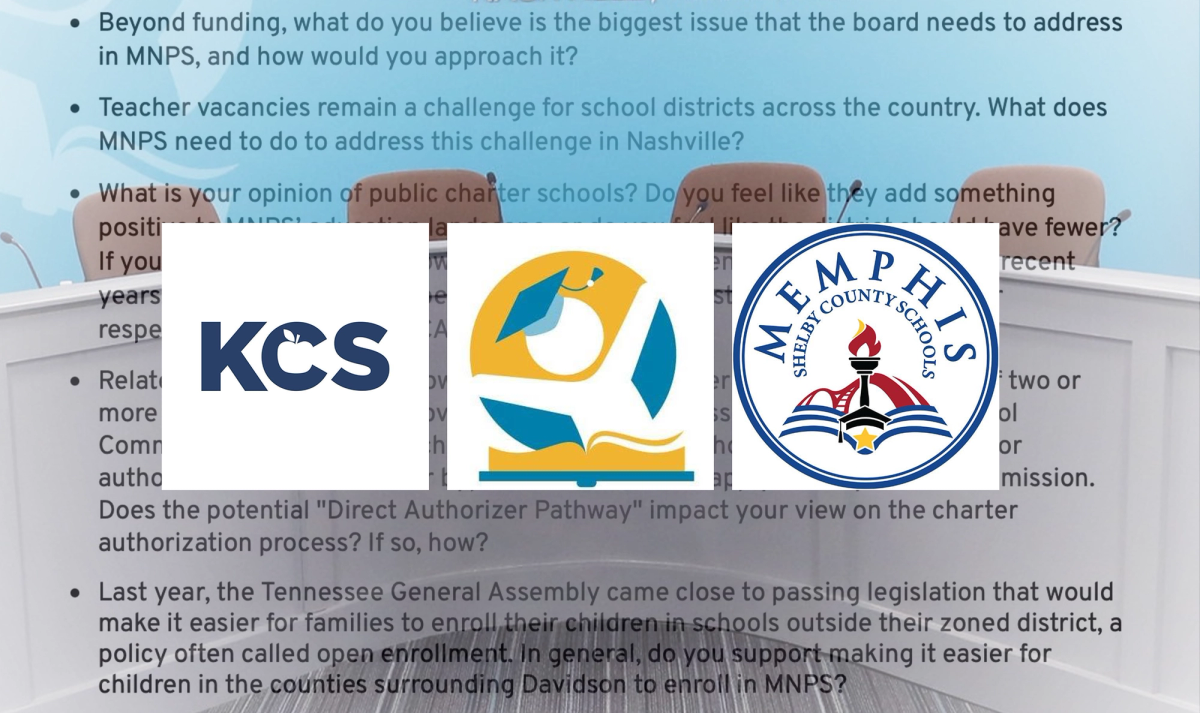
As part of an effort to expand transparency of board positions on key issues, the Tennessee Firefly sent a questionnaire to every board member of the three largest school districts in the state. These questions involved key issues that each will address in the coming year, now that the composition of school boards in Memphis-Shelby County Schools, Metro Nashville Public Schools, and Knox County Schools has been set by the August election.
Despite multiple conversations and emails over the last three weeks, the vast majority of board members across all three school districts chose not to respond to these important questions about public school choice and how they would address key challenges.
Just four board members responded to our questionnaire, including Zach Young and Robert Taylor from Metro Nashville Public Schools (MNPS), Tamarques Porter from Memphis-Shelby County Schools (MSCS), and Breyauna Holloway from Knox County Schools. Each provided detailed responses and positions that we’ve introduced, and in some cases edited for space, below.
Biggest Issue Beyond Funding
Firefly staff asked each board member what they view as the biggest issue in their district, beyond funding, and how they’d approach it.
Nashville’s two responding board members both discussed challenges that come from outside of the classroom. Young highlighted the need for the district to partner with organizations and other government agencies to address housing and transportation issues, while Taylor pointed to challenges in parental engagement.
“I believe one of the more pressing issues is parent engagement in the form of school support organizations like booster clubs, PTOs, and PTAs,” Taylor said. “I hope to address this by helping to support PTO academies to support parents who are interested in learning how to establish a school support organization (SSO). There are also some policies and procedures that can be revamped to ensure fiscal responsibility amongst parents involved in fundraising.”
“MNPS has made significant gains in recent years, and we should be proud of that progress, but districtwide success does not mean that every school or every student is experiencing the same outcomes,” Young said. “For me, the next phase of our work has to be about closing those gaps. That means identifying schools and student populations where outcomes are lagging, understanding why, and directing resources and support where they can have the greatest impact. But it is not enough for MNPS to focus only on the hours students spend inside our schools. What happens outside the classroom has an enormous impact on what happens inside it. Housing instability, transportation, mental health, family circumstances and other challenges can directly affect attendance, academic performance and a student's ability to succeed.”
In Memphis, Porter also discussed closing academic gaps. His solution is to borrow what’s working in other parts of the district.
“I believe our biggest challenge is consistency in the quality of education students receive from school to school,” Porter said. “A child’s ZIP code should not determine the quality of instruction, leadership, academic support, or opportunities available to them. The Board has to stay focused on measurable student outcomes while holding the administration accountable for implementation. That means identifying what is working in our highest-performing and fastest-growing schools, replicating those practices across the district, strengthening school leadership, supporting teachers, and intervening earlier when schools or students begin falling behind. We cannot wait until high school to address problems that began in elementary or middle school.”
In Knox County, Holloway pointed to a different issue that is also impacting districts across the state, challenges with aging facilities.
“The newest school in my district is roughly 50 years old and I believe the average age of the 14 schools in my district is around 90 years old with most schools not seeing major renovations in 30 years,” Holloway said. “I'm approaching it by going into each individual school in my district, speaking with administration and staff, taking a look at the schools and putting in maintenance requests that may not be getting put in or may not be getting addressed in a timely manner.”
Making it Easier for Open Enrollment
This year the Tennessee General Assembly came close to passing legislation that would make it easier for students to enroll out of district, sometimes called open enrollment. This issue is expected to return next year, and Firefly staff asked board members if they supported it.
Both MSCS Board Member Porter and MNPS Board Member Young expressed support for the concept of open enrollment, provided it didn’t place a burden on existing schools in the district.
“I support giving families options, and I certainly welcome families who believe Memphis-Shelby County Schools can provide the best education for their children. But any open-enrollment policy has to be implemented thoughtfully,” Porter said. “Our first responsibility is to the students and families who live within Memphis and Shelby County and already depend on our school system. We should make sure they have access to high-quality schools and programs before creating a system that could unintentionally displace them.”
“Any broader open-enrollment policy would need to protect opportunities for Davidson County students first and ensure that Nashville taxpayers are not being asked to subsidize the education of students from surrounding counties without adequate funding following those students,” Young said. “Capacity also matters. There may be schools or programs where MNPS has available seats and accepting an out-of-county student could make sense. There are others where Davidson County families are already competing for limited seats. I would not support giving an out-of-county student a seat at the expense of a Davidson County student who wants to attend that school.”
Knox County Board Member Holloway told the Firefly that she opposes open enrollment, in part, because she worries it would be misused for sports reasons.
“Hypothetically, I would have been in favor of students seeking a better education or environment to enroll in Knox County Schools if I had not been witness to the opposite happening when students, particularly student-athletes, are recruited outside of Knox County Schools to play sports at schools in surrounding counties,” Holloway said. “In both situations, school populations are decreased, which (affects) funding for schools, and sports are a revenue generator. If you take the top athletes out, your school loses revenue and support through that type of legislation and action. So, in summary, no, I would not support that.”
MNPS Board Member Taylor said he did not have enough information to answer questions about open enrollment.
Charter School Growth
All three districts have high-performing public charter schools, and each has received applications in recent years from organizations hoping to open new ones. Firefly staff asked each board member whether they support approving new high-quality applications. Charter schools are free public schools operated by a non-profit organization under a “charter” with a school district or the state.
Knox County Board Member Holloway was the only board member to express complete opposition to public charter schools. 
“My opinion is that charter schools are private schools cloaked as a similar alternative to public schools,” Holloway said. “I do not support public funds being taken away from public schools to support private or charter schools. The KCS School Board also has (no) oversight over the charter school. I would not approve of another charter school opening in Knox County. Our focus needs to be on bettering our existing public schools.”
In Nashville, Taylor and Young have been among the few board members to vote in favor of charter applications in recent years. Both said they are open to supporting high-quality charters schools, though Young said fiscal and enrollment realities need to play a role in any decision.
“With district enrollment relatively flat, opening another school does not create additional students. It redistributes students who are already attending schools in Nashville….At some point, spreading students across too many schools can make it more difficult for both district-run and charter schools to operate sustainably,” Young said. “I am willing to support innovative proposals that address genuine unmet needs. My vote regarding The Rock (Academy) demonstrates that. But with relatively flat enrollment, finite resources, and existing schools, including charter schools, that have available capacity, I do not believe responsible governance means continually adding new schools simply because an individual applicant may be capable of operating one.”
“My opinion of charter schools is that some are viable options for families, and some are not,” Young said. “My goal as an elected school board member is to represent the desires of the families we serve. I support high-quality educational opportunities for our children regardless of the packaging.”
MSCS Board Member Porter did not respond to questions about charter schools.
Direct Charter Approval
Unlike the other two districts, MNPS could see a major change to its charter school approval process this year. A new state law allows charter applicants to bypass local approval in districts that have had three charter application denials overturned.
Metro Nashville Public Schools could see that happen next month. Firefly staff asked both board members whether the potential “direct authorizer pathway” affects their view of the application process.
Both board members said it doesn’t, and Young went into detail about why.
“My responsibility as an MNPS board member is to evaluate the applications before us and make the decision I believe is in the best interest of MNPS students and Davidson County taxpayers. The possibility that another governmental body may ultimately reach a different conclusion should not cause me to vote for an application that I otherwise believe should be denied,” Young said.
Addressing Proficiency Gaps in Memphis
The Firefly asked MSCS Board Members a specific question about proficiency gaps. The district has seen proficiency rise on state tests, but middle and high school students are still 13 to more than 20 points below state averages.
Board Member Porter explained how he would address that.
“The improvements we have made show that our students can grow, but growth alone is not enough. We have to turn growth into proficiency,” Porter said. “For middle and high school students, that means stronger intervention in reading and math, more time on task for students who are behind, greater access to tutoring and high-dosage academic support, and making sure every classroom has strong instruction aligned with grade-level standards.”
Budget Challenges
One big challenge the Knox County School Board faced recently involved approving a revised budget to address a shortfall. Firefly staff asked Board Member Holloway what actions she’d like to see taken to prevent this from happening again.
“Knox County Commission in the future does not need to take any more money from the Knox County Schools budget, especially so close to the end of the fiscal year,” Holloway said. “Unless there is some type of disaster or County emergency that warrants and justifies surprisingly taking more money from KCS, there needs to be policies and protocols in place to prevent that from happening.”
You can read the complete responses from each board member here.