
Metro Nashville Public Schools (MNPS) leaders defended their decision to reject Music City Academy’s application for a new public charter school on Thursday, but the district's case before the Tennessee Public Charter School Commission rested less on the school's plan than on its price tag to the district.
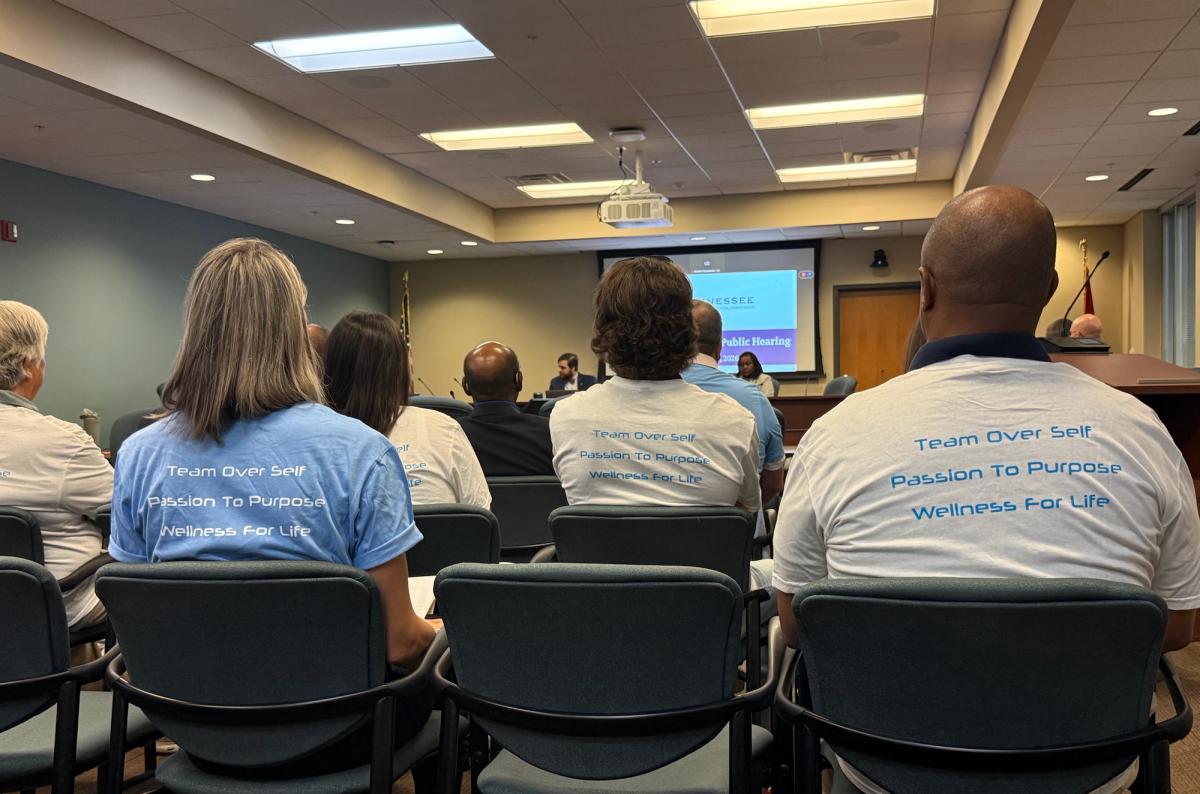
The MNPS Board of Education voted 7-1-1 in July to deny the amended application for the proposed tuition-free public charter high school, founded by former Tennessee Titans wide receiver and longtime educator Dr. Kevin Dyson. Board member Robert Taylor cast the lone vote in favor of opening the school. Dyson appealed to the state commission, which held a public hearing at the Davy Crockett Tower in Nashville for both sides to make their case about the potential school’s authorization.
In Tennessee, all charter schools are tuition-free public schools operated by an independent contract, or "charter," with an authorizing body like a school district or the state.
Music City Academy's amended application earned one of the highest district ratings for a Nashville charter proposal since 2014. District reviewers found it met standards in both its academic program and its budget and partially met standards in operations.
District Cites Fiscal Impact
MNPS representatives told the Commission the school met standards in Education Program and Design and Capacity, including its mission and model, as well as in Budget and Finance. Reviewers rated the operations plan as partially meeting standards, citing deficiencies in facilities, staffing, health and safety, start-up planning, and operations capacity, which the proposed operator addressed during the hearing.
But the district's central argument was financial. MNPS pointed to a provision of state law that allows a local board to deny an application if the new school would cause a substantial negative fiscal impact on the district. Under that law, the district bears the burden of proving the impact.
When Commission Executive Director Tess Stovall asked how the school would harm the district, district representatives said enrollment has held flat at roughly 82,000 students for years. About 60 percent of Tennessee Investment in Student Achievement (TISA) funding flows directly to schools, they said, so every new school divides the same students and dollars among more buildings.
"It is a pie, not a well," said Dr. Mason Bellamy, Deputy Superintendent, who spoke for the district alongside Shereka Roby-Grant, Executive Director for Charter Schools.
Stovall also questioned why reviewers faulted Music City Academy for lacking solidified plans for athletic facilities, since facility selection is not an authorization prerequisite in the state's scoring rubric. District representatives said that because athletics is central to the school's mission, reviewers expected a matching facility plan, and the application did not account for every sport the school intends to offer.
On staffing, reviewers acknowledged the school had hired a chief academic officer with experience launching a Nashville charter school. Still, they said the application remained vague about the school's executive leader and other key positions.
Music City Academy Pushes Back
Music City Academy (MCA) leaders described their mission as delivering "a rigorous, career-connected education through the unifying power of sports." Every student would join both an academic team and an athletic team, graduate with a college-prep core, and earn an industry-recognized credential in one of four career and technical education (CTE) pathways: sports medicine and health science, emergency services, therapeutic services, or audio/visual production.
"Athletics is the hook; academic excellence is the standard," school leaders told the Commission.
The school argued the district's fiscal analysis did not support a finding of substantial negative impact. By the district’s math, Music City Academy would represent 0.116 percent of the MNPS budget in Year 1. Still, Music City Academy presented data showing the fiscal impact would be closer to a 0.028 percent reduction once savings the district did not account for were included. MCA leaders also argued that state education dollars follow the student rather than belonging to the district.
On operations, Music City Academy said it has identified three potential facilities, two of them former schools, all under budget and near parks or athletic facilities. Leaders reported 62 prospective teachers and staff, 480 signatures of community support, and 162 letters of intent from Nashville families.
Stovall pressed the school on its budget after no new-start school received federal Charter School Program (CSP) funding this cycle. School leaders said they are already 87 percent of the way to their pre-opening budget, and they expect about $625,000 more in commitments contingent on approval.
MCA leaders also affirmed their commitment to partnerships for athletic facilities access, citing opportunities with key leadership from both Tennessee State University and Vanderbilt University. Providing access to strong academics, career-connected learning, and athletic opportunity remained central in Music City Academy’s statements and responses.
Public Comment
MNPS board members Rachael Anne Elrod and Erin O'Hara Block spoke in support of the district's denial. Block, who made the motion to deny, said she did so because of the fiscal impact, regardless of the school model or its potential quality.
MNPS Chief Financial Officer (CFO) Caitlin Richard said the district operates 154 schools, or 164 when counting commission-authorized schools, and that adding more schools spreads the same students and dollars across additional buildings and administrative costs.
None of the comments supporting MNPS’s decision to deny the school hinged on the school’s application quality or opportunity for students; instead, they cited the potential financial impact on existing district operations.
Nine people spoke in support of Music City Academy, including Tennessee Titans Chief External Affairs Officer Adolpho Birch, who previously served on the board of an NFL-affiliated high school in New York City.
"The academy looks to provide students with a broad education, not a sports factory, but a career and college school rooted in sports passion," Birch said.
Sparkle Jay, a nurse and president of the Isaac Litton Middle School PTO, said she is one of the families ready to enroll.
"Families have a voice in this decision," Jay said. "(We) want schools that challenge our children, help them feel connected, and prepare them for life after school."
Lisa Stone, Director of Fellows for the Nashville Incubator, said the organization will stay involved with Music City Academy for its first two years of operation, committing to executive coaching for the school’s leadership team and continual advising to ensure the school’s success.
A Pattern of Denials
The MNPS board has not approved a new public charter school since 2021 and denied every application this year for the fifth straight year. The state’s Commission has overturned at least one MNPS denial every year since 2021. Under state law, if the Commission overturns three of a district's denials within three years, charter applicants in that district may bypass the local board and apply directly to the Commission for the next five application cycles.
Next Steps
Executive Director Stovall will issue a written recommendation before the Commission votes on Music City Academy's appeal at its quarterly meeting on October 9. The public may submit written comments until 9 a.m. CST on Oct. 1. If approved, Music City Academy plans to open in August 2027 with a founding ninth-grade class.
Interested families can learn more about Music City Academy at https://www.musiccityacademy.org/.